Blog Archives - Page 15 of 16 - Massage Revolution

The Best Neuromuscular Trigger Point Massage Los Angeles Offers: What conditions does Neuromuscular Massage help?

NMT successfully addresses and eliminates pain associated with: Back Pain, Neck Pain, Shoulder Pain, Headaches, Migraines, Carpal Tunnel, Herniated Discs, Scoliosis, Knee, Hip, Foot, or Joint Pain, Rotator Cuff (shoulder problems), Sports Injuries, TMJ, Whiplash, Tennis Elbow, Fibromyalgia, Osteoarthritis, Plantar Faciitis, Torticollis, Thoracic Outlet Syndrome, Shin Splints, Tendonitis, Spasms, Cramps, Strains, Postural Distortions, Post Polio Syndrome, Poor Posture, Stress, Tension, and more…Neuromuscular Massage gets to the SOURCE of your pain, whether you experience an aching, throbbing, burning, stabbing, tingling, piercing, grinding, tension, stiffness, restriction, clicking or pounding sensation. Call today and request the best Neuromuscular Massage Los Angeles offers for longer lasting relief at our massage center in Manhattan Beach.

How Weird Ache in Her Middle
Back Finally DISAPPEARED!

-Chanice B.

Neuromuscular Trigger Point Massage: Most Effective Treatment for Neck & Back Pain – How to Get Started.

Many people that suffer from recurrent or chronic neck or back pain have likely tried all manner of “cures” and are probably skeptical that there is anything that can work for them. However, the fact of the matter is that neck or back pain can be cured permanently. The first step begins by learning as much about your condition as you possibly can. To keep oxidative stress and systemic inflammation at bay, you need to drink plenty of water, eat a balanced diet, as well as an anti-inflammatory diet. This may mean a diet low in sugar and gluten-free. Everyone who suffers from back or neck pain or headaches has trigger points. Seeing a qualified neuromuscular / trigger point massage therapist to releases and deactivate your trigger points is step one to eliminating your pain. Doing the proper Postural Realignment Exercises to restore your muscle imbalances is step two. Take time off occasionally to relax and meditate. Reacting to stress less reduces the agitation and frustration in your body which causes muscles to tighten and spasm.

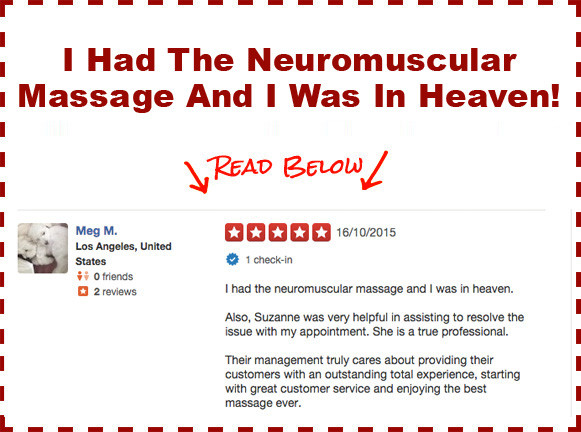
Learn Why People Drive From All Over
Los Angeles Country To See Us !

Neuromuscular Trigger Point Massage: What Not To Do For Neck Pain Relief.

The last thing you want is to make your neck ache or pain worse, which is exactly what you risk doing when you attempt to heal it with an exercise program. You simply cannot get rid of neck pain with strengthening exercises, if the muscles are short, tight and filled with pain-causing trigger points. If you try, you risk re-injury. The best first line of defense against an aching, stiff neck is to get the muscle spasm and trigger points removed right away by a qualified neuromuscular/trigger point massage therapist. Doing so get’s all the “land-mine” knots out first, so you’re then able to stretch the muscle and eventually strengthen it. To truly get out of neck pain for good, you must try to “lengthen before you strengthen!”

What Not To Do For Neck Pain Relief

Neuromuscular Trigger Point Massage: This Hip Muscle Causes TONS of Back Pain.
Do you have back pain going into your buttocks and hips? Can’t find a comfortable sleeping position or got pain in your hips and low back walking? If so, trigger points in your gluteus medius muscle are very likely the cause of this, not arthritis, a herniated disc, compressed nerve, or spinal dysfunction. It’s quite common and frustrating to many of these back pain sufferers that after years of bouncing around from one doctor to the next, it turns out that a neuromuscular massage therapist holds solution and key to relief by simply releasing these landmine knot trigger points in the gluteus medius muscle.

To Book Your Massage, Call 310-798-4263!

Click Here To Claim This Offer


Mental Attitude: Increasing Depression May Indicate Greater Dementia Risk.

Depression is a known risk factor for dementia, but most studies have only focused on depression at a single point in time and not over a multi-year time frame. In this study, researchers looked at the depressive symptoms of 2,488 seniors over a five-year time period and then followed up with them over a decade later. They found that those with high and increasing depressive symptoms during the data collection period were nearly twice as likely to develop dementia than even those with moderate depressive symptoms.

JAMA Psychiatry, March 2016

Call 310-798-4263 Now!


Pain Management: Tennis Not Dangerous to Teen Spines.

Many health experts believe that tennis and other asymmetrical sports pose risk factors for scoliosis development in adolescents even though scientific data is lacking. A new study that involved 102 adolescent tennis players failed to find a correlation between tennis and either an increased risk for low back pain or spinal deformities among adolescents.

European Spine Journal, February 2016


To Book Your Massage, Call 310-798-4263!


Health Alert: Lawn Mowers Pose Dangers to Kids.

Children in the United States continue to suffer severe injuries from both regular power lawn mowers and ride-on mowers. Currently, the American Academy of Pediatrics recommends that no child under the age of 16 operate a ride-on mower and no child under twelve operate a push mower. Additionally, they urge parents to keep all children under the age of six indoors when any mower is in operation and not to allow kids to ride as passengers on mowers operated by adults. A recent study found that over 50% of kid-related mower accidents resulted in an amputation. Senior study author Dr. Douglas Armstrong explains, “People don’t realize how dangerous lawn mowers are… The vast majority of the injuries could have been prevented if safety guidelines had been followed.”

American Academy of Orthopaedic Surgeons Meeting, March 2016

Got Any Questions, Call 310-798-4263!


Diet: Omega-3s May Lower Breast Cancer Risk Among Obese Women.

The National Cancer Institute (NCI) reports that women with dense breast tissue have a four to six times increased risk of developing breast cancer. Now, a randomized clinical trial involving 266 postmenopausal women has found an association between increased levels of omega-3 fatty acids in the blood and reduced breast density, but only among obese participants. The researchers singled out DHA (docosahexaenoic acid) as the fatty acid associated with breast density reduction and they hope to examine the effects of DHA in a trial involving obese participants known to have dense breast tissue. Researcher Dr. Andrea Manni adds, “The finding supports the idea that omega-3s, and specifically DHA, are preferentially protective in obese postmenopausal women.”

Cancer Prevention Research, December 2015

To Book Your Appointment, Call 310-798-4263!


Exercise: Being Physically Fit Reduces Depression Risk After Heart Attack.

People who are physically fit may be less likely to become depressed after a heart attack. Researchers looked at 189 middle-aged and older Norwegians and found that those who exercised regularly in the years preceding their heart attack were less than half as likely to become depressed after a myocardial infarction than those who rarely or never exercised. The findings are important as heart attack survivors are three time more likely to have depression. Though the study did not prove cause and effect, it certainly appears that exercise protects against depression after a heart attack.

The American Journal of Medicine, February 2016

Click Here to Read More Success Stories!


Wellness/Prevention: Probiotics May Prevent Dental Cavities.
In the future, preventing cavities may be as simple as taking a supplement to keep unwanted bacteria in check. Researchers have found a strain of bacteria that could keep bad bacteria under control and pave the way to using probiotics (beneficial bacteria) to prevent cavities. The newly identified bacteria is a strain of Streptococcus called A12, which was found to help neutralize acids in the mouth and also kill Streptococcus mutans, an especially harmful kind of bacteria. The findings are important as too much acid can cause dental cavities or other disorders. While the development of an effective oral probiotic is still a long way off, this previously unknown bacteria looks like a promising candidate in the future of dental health.
Applied and Environmental Microbiology, January 2016

There’s finally new hope for back, neck, and ALL chronic pain sufferers.

The 1-2 pain punch of our Neuromuscular Massage treatments with Chiropractic almost guarantees you a much quicker end to your fight to stop your pain for good.

Every Monday, you’re able to now get your Chiropractic treatments and begin your week feeling great.

Call our receptionists at 310-798-4263 to schedule your first Chiropractic appointment and Neuromuscular Massage today, and discover the most safe, effective, and lasting 2 treatments most doctors don’t know about…

The combined relief of these 2 methods is amazing!

The first 8 people to come in on "Chiropractic Monday" get a FREE bottle of Biofreeze pain relieving gel (value $15).

Read the benefits of Chiropractic below for Back Pain, Neck Pain, Fibromyalgia, Headaches, and more!

Possible Benefits for Those with Fibromyalgia.
A new study reveals the benefit of chiropractic treatment in the management of fibromyalgia. During a three-month study, 120 women with severe fibromyalgia received treatment that included education, cognitive behavioral therapy, and an exercise component. One half of the group also received chiropractic adjustments to the cervical spine during this time. Outcome assessments showed the group who also received chiropractic care experienced greater overall improvement when compared with the group who did not receive spinal manipulative therapy. The researchers conclude that adding chiropractic care to current treatment plans for fibromyalgia patients may improve their overall results.

Rheumatology International, July 2015

Resolution of Daily Cervicogenic Headaches.
A 13-year-old patient with a complaint of daily headaches presented for a trial of chiropractic care. His doctor of chiropractic utilized spinal manipulation to treat cervical and thoracic spinal joint fixations, which a thorough examination had revealed to be the possible underlying cause of the adolescent’s chief complaint. The patient reported his headaches resolved during the course of treatment, which consisted of eight visits over two months. This case documents the potential benefits of chiropractic care in the management of headaches in adolescents.

Journal of Pediatric, Maternal & Family Health, April 2015

Spinal Manipulation Helps Patients with Thoracic Spinal Pain!
A review of the existing literature related to the non-invasive, non-drug treatment of thoracic spinal pain found that spinal manipulation, a treatment performed by doctors of the chiropractic, is the only treatment with critically appraised and relevant research demonstrating that it results in statistically significant reductions in thoracic spinal pain.

Journal of Manipulative and Physiological Therapeutics, July 2015

Can Migraines Be Caused By a Neck Problem?
For some patients with migraine headaches, treatments aimed at alleviating nerve compression in the neck may lead to reduced headache severity and frequency, or even lasting relief. This adds to a growing body of research that some patients with migraine headaches may benefit from treatments intended to improve cervical function, such as chiropractic care.

Eplasty, June 2015

What Factors May Increase a Patient’s Risk for Another Back Pain Episode?
Researchers conducted MRI scans on 76 patients who had an episode of back pain within the previous three months and followed them for a year in an effort to identify any factors that may indicate whether or not a patient may experience future back pain episodes. After comparing the MRI findings and case history of each patient who had a recurrent back pain episode with those who did not, the researchers found that patients with disk degeneration were 89% more likely to have another episode of back pain within the next twelve months when compared with patients without MRI-confirmed disk generation. For patients with a bulging disk, the risk for a recurrent episode was 84% greater than those without a disk bulge. They also found that each previous episode of back pain increases a patient’s risk for a future episode by 4%

Spine Journal, July 2015

Should You See a Chiropractor First?
Swiss researchers contacted 719 patients who initially visited either a doctor of chiropractic (DC) or medical doctor (MD) for either spinal, hip, or shoulder pain. The patients who sought care from a DC first reported higher scores for both satisfaction with the care they received as well as the outcome of care. The researchers add that the total costs associated with patients who sought chiropractic care were four-times lower than those who sought medical care first.

Journal of Manipulative and Physiological Therapeutics, August 2015

Eye Surgeons Get Neck Pain Too!
Musculoskeletal injuries can affect workers in many industries, even skilled surgeons. A new study published in the journal Current Opinion in Ophthalmology notes that ophthalmic plastic surgeons are at a high risk for cervical musculoskeletal disorders due to the amount of time they spend working in awkward, prolonged, static, and asymmetric postures. Additionally, wearing equipment on the head such as head lamps and magnifying devices can increase the weight of the head up to 40%, placing extra strain on the neck. Because 10% of cervical injuries in the profession will end a career, the authors of the study recommend that ophthalmic plastic surgeons take neck pain seriously and seek professional help when needed.

Current Opinion in Ophthalmology, July 2015

Specific Chiropractic Technique Helps Stenosis Pain and Disability.
A study involving thirty patients with lumbar spinal stenosis found that flexion-distraction is an effective intervention for reducing both the pain and disability associated with this condition. In the study, half of the patients underwent a course of physical therapy while the other half received flexion-distraction treatments three times a week for six weeks. While both groups reported improvements in pain and disability, the results were more significant in the flexion-distraction group.

Journal of Physical Therapy Science, June 2015

Scientists are in the middle of having this really profound, revolutionary revelation: the human body evolved to do the stuff that we used to do a few thousand years ago. This might sound like a no-brainer, but it has a lot of very profound implications for everything from what we eat to how we hurt ourselves.

You see, humankind didn’t evolve in a chair. We built chairs to give our butts a place to go when we wanted to be still for a while — but until the past few hundred years, sitting still was a luxury we rarely had. Even in the Middle Ages, most everyone worked the field, forged the horseshoe nails, or otherwise was on their feet exerting themselves for most of the day. Only since the Internet became the dominant sculptor of daily life do we spend 8+ hours per day on our butts in front of screens, moving our fingers more than we moved any other parts of our body.

What happens when you sit for a long stretch every day for a long stretch of days? Pretty simple: your back muscles atrophy and we forget — literally, our muscles forget — how to stand and walk about correctly. The muscles that we use to stabilize our lower backs wither, and we find that the only things between our butt-bones and our chair is some thin denim…no muscles.

Fortunately, there’s a solution that science has started to see excellent evidence of — if we go back and do the kind of thing we did a few thousand years ago, our bodies will recover. Those muscles re-develop, and as long as we don’t train ourselves to continue our horrible mistakes in posture, we regain almost all of the body mechanics we’re used to.

That’s right — you can walk away your back pain. Studies in Norway revealed an inverse relationship between back pain and physical activity: the more active you are, the less likely you are to report that your back hurts. The study specifically pointed out the degree to which simple walking helps. Even senior citizens who regularly walk report less disability than those who are sedentary.

Of course, if you do manage to develop a postural distortion, you can walk all you want and still end up with a pain in the back. That’s when you need to consult a neuromuscular therapist to perform a posture alignment assessment and suggest some muscle lengthening, strengthening, and endurance-building exercises that help you get your posture back on track. Once you’ve got the right gait and stance, very little beats a simple walk as an excellent treatment for everyday back pain.

Every once in a while, a muscle group won’t respond to the usual exercises — instead, it will quite readily knot itself up into a tight ball of unresponsive pain. If that sounds familiar to you, your therapist may suggest something like a trigger point system  to help you ‘unlock’ your pained muscles. With the help of a powerful all natural anti-inflammatory  and releasing your trigger points, you’re able to get almost any muscle released and out of pain.

Ultimately the best solution is to consult a qualified Neuromuscular Massage Therapist!

Back pain — especially lower back pain — is probably the single most common complaint in American society. Some people have genetic factors that make them more inclined toward back pain than others; some have injuries they got in high school or earlier that changed the way they stand or walk that resulted in long-term, low-grade muscle strain. Then there are people whose jobs or home lives demand that they work those muscles — or, in the case of the cubicle jockey, completely fail to work those muscles — every day.

Fortunately, for those last two groups — the over-workers and the under-workers — there are fairly simple solutions.

The Science of Lifting

If you have a job that requires you to lift awkward or heavy loads often, learning how to lift properly is crucial to reducing back pain. Lift with your back straight, your entire body facing the same direction (never lift while twisted), and by providing most of the power with your legs. Align your shoulders, hips, and feet so that the weight of the object is passed directly onto the floor without unnecessary muscular effort.

The Science of Sitting

Ergonomics was huge a decade ago; it was the science of figuring out how to make it most comfortable to sit in the same position for hours on end. Unfortunately, as much as ergonomics tried, the human body isn’t made to sit in the same position for hours on end; it causes enormous strain on the lumbar muscles. The solution is simple: get out of your office chair every 45 minutes and spend just 5 minutes on your feet, moving around.  Even a long-distance truck driver with the world’s most comfortable anti-vibration seat needs a break at least every hour and a half to avoid lower back pain.

While you do sit in your chair, sit in it properly: ears, shoulders, and hips lined up vertically to reduce strain on your spine. If you have a keyboard, your chair should be lined up so that your elbows can be on your armrest while your wrists are on your wristrest. If you’re driving, shift your arms’ positions regularly so that no one set of muscles is constantly picking up the strain.

Every occupation naturally has its own risks, demands, and proper approaches. Talk to your boss about safety and injury reduction at your workplace; most modern jobs have plenty of information about the subject at hand. If you have an office job, consider investing in a back pain relieving office chair. If you do end up injuring your back, pick up a bottle of a powerful, all natural anti-inflammatory and lay off for a day or two to give your back the chance to heal.

Ultimately the best solution is to consult a qualified Neuromuscular Massage Therapist!

People with chronic lower back pain are familiar with the sensation: you may have had days, weeks, or even months of normalcy, and then — a twinge.  A wince, and it’s back. The only question is, how long is it going to plague you this time around?

Back pain affects a person off and on for years, and unfortunately, the only real ‘solution’ that you get without professional help is to not exert yourself or put any strain on your back — which is almost impossible. Your back is built to take strain; its whole purpose is to hold up your body, after all.

One of the most common suggestions for people who have lower back pain is that they stretch it out. This isn’t a bad suggestion in most circumstances; stretching really can be quite helpful for a stiff or sore back. But for many people who have chronic back pain, a simple stretch doesn’t even begin to touch it. So what do you suggest after that?

First releasing the trigger points, or “landmine knots” that keep your muscles locked up, actually allows your muscles to effectively stretch. You may have tried to stretch your way out of pain, yet scientific research proves that it’s actually your trigger points that lock up your muscles and cause over 80% of chronic muscle pain. Stretching does nothing to relieve trigger points. The only way to release and de-activate trigger points is by self-treatment or seeing a qualified Neuromuscular Therapist.

Stretching may also actually do more harm than good. Stretching is great for preventing problems, but not so much for treating them once they’ve cropped up already.

That’s because stretching your lower back inherently lengthens the muscles and connective tissue in and around your spine. Stretching an already strained muscle or lightly sprained tendon or ligament can weaken the tissue and lead to greater instability or balance problems, which leads to even more back pain.

If you stretch a pained back and find that your pain increases either immediately or the next day, you need to seek the counsel of a neuromuscular therapist. Such an expert is highly qualified to release your trigger points, and tell you about the exercises you need to do in order to overcome your back pain without causing more stress on already-injured muscles.

Generally, a great first step is to add a powerful anti-inflammatory to your regimen. Inflammation is a natural reaction the body has to even minor muscle strains or ligament sprains, and it causes amazing discomfort, especially if it happens near the spine.

Ultimately the best solution is to consult a qualified Neuromuscular Massage Therapist!

Every year, America’s surgeons perform hundreds of thousands of back surgeries — it’s one of the most common surgical operations in the country. Discectomies, laminectomies, spinal fusions — the number of variations on ‘back surgery’ is amazing. Even more amazing is the fact that most of these surgeries are perfectly avoidable if the initial herniated or slipped disc is treated properly and promptly. Unfortunately, ‘proper’ treatment is a rarity in a medical environment where the response to pain is almost always ‘drug it away and rest a while’ and maybe get a little physical therapy. In many if not most of these cases, a trained neuromuscular therapist could have averted the need for surgery altogether.

Patients who have persistent pain or numbness after back surgery are rather tersely described as ‘surgical failures’, and their problems are known as ‘failed back surgery syndrome’. It’s chronic, because once your body is altered by surgery, there’s no way back. Re-operation is complicated at best and has chances of making things significantly worse. For many who attempt re-operation, the final option is to have a device implanted into their spine to quell the pain.

In short, back surgery should be reserved only for cases where a flaw with the spine is causing pressure against a nerve root, and the affected limb is suffering numbness, muscle atrophy, or constant pain as a result.

That’s because, if those aren’t your symptoms, the chances are approaching 100% that you’re able to get a non-surgical cure that doesn’t come with all of the risks of surgery. The vast majority of back pain is caused by musculoskeletal problems — if you’ve injured a muscle, tendon, ligament, joint, or disc in your back and never had a neuromuscular professional examine you, it’s probably still affecting you. Subtle changes in the way you stand, sit, and move due to long-forgotten injuries cause a surprising amount of pain — pain that can’t be corrected by surgery. Heck, for some people, a simple anti-inflammatory supplement can end a startling amount of back pain.

That’s why a neuromuscular therapist is the right person to talk to – they’re able to identify muscle imbalances and postural issues and help you correct them, even if you need special support in accessing and ‘undoing’ certain muscle groups in order to do it. With a combination of trigger point therapy, alignment exercises, and flexibility, strength, and endurance-building, they’re able to guide your body back to its ‘normal’, correct posture and end many if not most cases of chronic low back pain with much less cost than surgery.

The biggest problem that modern medicine has trying to address something as commonplace as back pain is that modern medicine is built from the get-go on the scientific process that involves eliminating variables and narrowing everything down to a single traceable cause. But the human body isn’t the kind of thing you can experiment like that on.  Your whole body works as a unit, and every change you make to one variable affects dozens of other variables down the line.  There’s no such thing as ‘isolating a factor’ when it comes to the human body.

Take back pain, for example: is your pain a sporadic, sharp and shooting pain? That might be because you have a problem with your vertebrae and the bone is pinching a nerve — but it’s more likely that there’s a tight, inflamed muscle that’s injured and the internal swelling is squeezing that nerve. You can cure injured muscle spasms in the back with the help of a trained professional, yet you also must make sure that it has everything it needs (i.e. nutrients, posture awareness) to heal itself.

You can take a high quality, natural anti-inflammatory to help the swelling go down and stop the squeezing on the nerve and help the muscle heal. Most doctors give you a prescription for something stronger than Asprin and send you on your way, giving you exactly nothing to help that muscle get better and ensuring that the pain lasts as long as possible.

There are so many factors that go into a ‘simple’ muscle strain. You need to have a professional assess your:

  • Muscles
  • Trigger Points
  • Ligaments
  • Tendons
  • Posture and alignment
  • Movement
  • Any potentially relevant scar tissue

And the kicker is that these affect each other, so if you learn that your posture is off, it may be causing your muscles to overwork and become strained — OR it may be that you have a muscle that’s already strained and your posture is subconsciously adjusting to accommodate the muscle. Just hiding the problem under a typical prescription pain reliever isn’t going to actually fix anything — and in fact it makes fixing the problem in the future that much more difficult.

Instead, follow this five-step system in order to ensure that the muscles in your back and neck are able to heal most effectively. Most back pain is muscular and the result of repeated strains within the back –so these steps heal most peoples’ back pain.

Step 1: Relieve the Muscles and Trigger Points

Quite often, the strain in your muscles either causes or is caused by a muscle or a set of muscles that simply does not relax. Fortunately, every muscle comes equipped with ‘trigger points’ that when released, relaxes the muscle. Even a muscle that cannot be stretched out manually is relaxed with trigger point therapy. In most cases, you need the help of an expert Neuromuscular Therapist like we have on staff, or a do-it-yourself trigger point kit to access the trigger points on your back muscles.


Step 2: Fix Your Posture

Once your muscles are done being so “angry” and allow you to stand normally, it’s time to make sure that you’re doing exactly that. Posture alignment exercises help you restore balance to your stance, which minimizes strain on your ligaments, muscles, tendons, and even your internal organs. If you sit at a desk all day, it’s crucial that you have the best chair for bad backs to keep your back and pelvis healthy.


Step 3: Restore Flexibility

There’s a significant difference between a relaxed muscle and a flexible muscle. A muscle that helps you stand and walk correctly may very well still be too short and tight to respond effectively to the demands made as you perform everyday tasks like carrying groceries in from your car. During this time, any residual inflammation can be particularly hampering; supplementing with a powerful anti-inflammatory  is a great idea.


Step 4: Restore Strength

As your muscles get ‘long’ and able to stretch, it’s time for some functional strength training. You should be almost entirely pain-free by this time before you do any strength training; what we’re doing here isn’t so much solving the old problem as making sure that it doesn’t come back.


Step 5: Build Endurance

Continue your flexibility and strength exercises, but add in isometric and other endurance-building exercises. This ensures that even if an extreme demand on your muscles suddenly arises, you’re able to handle it without the pain coming back.

The key to eliminating pain and preventing re-injury is to do steps 1-5 in order.  You must release your trigger points first, since they are the root cause of 80%+ of chronic muscle pain.  You can’t stretch a muscle well unless the trigger points are released first.  Also, when you do strength training too soon, like so often in physical therapy, you run the risk of re-injury and more pain.  Get your trigger points released and then move on to the strengthening later.

If you’re not sure how to accomplish these goals, you want to consult one of our expert Neuromuscular Therapists. With their care and your own focus, you’re able to eliminate the majority of the back pain in your life.

“A wise man should consider that health is the greatest of human blessings, and learn how by his own thought to derive benefit from his illnesses”.
~ Hippocrates

Mental Health: The Relaxation Response: Learn It!

Researchers at Harvard recently took a pile of 28 people who had never meditated or done anything similar in their lives, and taught them the simplest form of what they call the ‘relaxation response’ — by talking them through a muscle-by-muscle relaxation of their entire body while they repeated a mantra. They essentially Pavlovianly trained these folks to relax when they invoked their mantra, in the same way that Eastern monks who regularly meditate relax by closing their eyes and taking a deep breath. The benefits of learning to enforce relaxation? “[The relaxation response] produces immediate changes in the expression of genes involved in immune function, energy metabolism and insulin secretion,” the study says. In other words, you resist bugs more effectively, burn more calories, and store less fat — oh, and your stress levels plummet, too.
Science Daily, May 2013

Health Alert: ‘Five Second Rule’ Proven True…ish

Two separate studies examining the speed with which bacteria and other grossness on the floor gets transferred to your food have used very similar methods and received very similar data…and somehow managed to end up at nearly opposite results. The more liberal group essentially said that the five-second rule is probably OK given that the food gets dropped in your own home (where the bugs are ‘your bugs’ and you’re used to them) — not so much on the street or even in someone else’s house. The conservative group looked at the same data and concluded that “there is no five-second rule…eating food off of the floor is as dangerous as driving without a seat belt on, even after zero seconds.”
National Geographic Magazine, March 2014

Diet: Ketogenic Diet Can Fight Cancer!

Dr. D’Agostino, an assistant professor at the University of South Florida Morsani College of Medicine in the Department of Molecular Pharmacology and Physiology, has been studying the effects of extremely low-carb ‘ketogenic’ diets, and believes that cancer sufferers can manage their tumors metabolically. It turns out that cancer cells don’t burn fat for energy — only sugar — but humans who simply don’t eat any sugars will (after some suffering) naturally switch over to burning fat and fat alone for energy, which essentially starves the cancer, sending it into remission.
The Examiner, March 2014

Exercise: Obese People Don’t Get Any Exercise…and Should

It’s fairly common knowledge that obese people should exercise more, but a recent study revealed just how much they need to work at it — a study by the Mayo Clinic found that obese women get at little as one hour of aerobic exercise…per year. Men faired little better, with obese men averaging just four hours of exercise per year. Their conclusion: even if it’s just five minutes a couple of times a week, getting tiny amounts of exercise and working to increase that amount slowly — even over years and years — will improve these peoples’ quality of life (and lifespan) significantly.
Time Magazine, February 2014

Neuromuscular Massage: Myofascial Pain: A Sticky Subject

The term ‘myofascial pain’ is fairly common (and getting more so) but not that many people have a clear idea of what it means. Here’s what it means: the ‘fascia’ are like envelopes of slick tissue that surround almost every part of our internal body. Imagine the thin, clear layer you can often find in top of a skinless chicken breast. ‘Myofascia’ means ‘fascia around your muscles’ — so ‘myofascial pain’ is ‘pain caused by a problem with the tissues that envelop your muscles.’ This happens most often when small tears in the myofascia cause them to adhere to nearby other tissues. Massage or other forms of directed pressure can release the adherence and thus allow the myofascia to return to their proper place (and stop hurting!)
Click here to learn more about Neuromuscular Massage

Academy of American Family Physicians, February 2002

Ergonomics and Proper Posture: Does Your Office Chair For Back Relief Do This?
The office chair market is drowning in the word ‘ergonomic.’ There isn’t an office chair produced in the world today that isn’t ‘ergonomic’ — yet we’ve seen nothing but an ever-increasing amount of back pain. Chairs that are ‘ergonomic’, in fact the entire science of ‘ergonomics’, have failed us. If you want a serious back pain chair, you need the next evolution…Click Here to Read About the Ultimate Chair for Back Relief.

Wellness/Prevention: Knowing What Your Risks Are

Anne Wojcicki, founder of genetics testing lab 23andMe, put on a TED talk regarding some of the benefits of knowing your genes, and while 23andMe is currently prevented from giving out health advice based on their genetic findings, it’s almost certainly only a matter of time before that gets sorted out. Once they’re back in business, it should be considered an investment in your own future health to get yourself profiled — their results will tell you, for example, whether to worry more about cancer, heart attack, Alzheimer’s, or something altogether different. From there, you can decide for yourself what preventative measures suit your lifestyle.
Engadget, March 2014

Alternative Medicine: Herbal Remedies for Back Pain – the most common and uncommon!

There are a mountain of powerful, all-natural herbs in the world that help the human body heal in a vast number of ways. If your back hurts, for example, there are more herbal remedies for back pain than you can shake a stick at. Here’s just a rough sampling of a few…Continue Read Here

“The best six doctors anywhere, and no one can deny it Are sunshine, water, rest, and air, exercise and diet.”
~ Wayne Fields


Mental Health: Living At High Altitude Linked to Depression, Suicide

Utah researchers recently uncovered a startling factoid: while the folks in Utah tend to be some of the physically healthiest in the country, they also have some of the highest rates of mental illness. In fact, in the greater context of the Rocky Mountain states, the cities that sit high atop the mountains tend so strongly toward depression that some have started referring to the mountains as the ‘suicide belt.’ The theory is that living at high altitudes alters your brain chemistry and promotes depression, schizophrenia, and suicide. The theory falters on a global scale, however, as countries like Bhutan and Nepal are high-altitude countries with significantly better mental health overall than the U.S.
Salt Lake Tribune, March 2014

Health Alert: Autism Linked With Environmental Toxin Exposure…and Genes

Researchers from the University of Chicago, led by professor of genetic medicine Andrey Rzhetsky, analyzed data of nearly 100 million children gathered from different states in the United States to measure autism rates and intellectual disability. The study was epidemiological in nature, which means it didn’t focus on finding a single ‘smoking gun’ chemical that was ‘at fault’ — but what they did find is that there is significant evidence that autism happens when certain genetic states coincide with certain environmental circumstances. A glance at the map that comes with the study seems to point to high-fracking areas as being high-autism areas in general, though that may be purely coincidental.
Autism Speaks, March 2014

Diet: ‘Free Sugars’ Strongly Linked to Heart Disease

JAMA last month contained a large study that linked ‘sugar as a percentage of caloric intake’ to ‘death from cardiovascular disease’ and found that the correlation between the two was startling. We all know by now that correlation doesn’t imply causation, but nevertheless the World Health Organization is revising its guidelines, suggesting that ‘free sugars’ (in other words, sugar added to food rather than those naturally occurring within food) should comprise 5% of less of your total caloric intake. (For the record, that would put almost every American breakfast food off limits.)
The Journal of the American Medical Association, February 2014

Exercise: Late-Night Exercise Won’t Mess Up Your Sleep Schedule

The National Sleep Foundation Sleep in America Poll for 2013 finally came back a few weeks ago, with interesting results. It seems that people who get at least 30 minutes of aerobic exercise sleep better at night — no surprise there. But even people who get that exercise right before bedtime sleep better than people who don’t get it at all — so the old theory that you should use the hour before bed to relax and do nothing has been officially tossed. If you can’t sleep, get some exercise, and try again.
Prevention Magazine, March 2014

Neuromuscular Massage: Amazing Treatment for Back, Neck, Hip and Knee Pain: Pain and Posture

A study from IPSB college showed that in people with chronic hip, knee, and back pain, a simple assessment of their posture can lead to new potential avenues of treatment. They assessed the pelvic tilt of people who reported many years of chronic hip, knee, and back pain. Then, they applied neuromuscular massage therapy intended to correct the posture of the patients — and when the five-week process was complete, they verified that complaints of pain were reduced in rough alignment with the correction of the pelvic tilt accomplished by the neuromuscular massage.
IPSB college, June 2008

Wellness/Prevention: Even Prevention Can Be Overdone

A massive study out of Canada last week revealed that preventive medicine can be taken too far. It turns out that there was zero difference in breast cancer mortality between women ages 35-60 who had annual mammograms and those who did not. What did change was that the women who received mammograms had more false positives, meaning lots of unnecessary fear, stress, and medication.
Modern Healthcare Magazine, February 2014

Massage Revolution is LA’s #1 Pain Relief Massage Center

Fast, lasting relief—plus expert therapeutic massage when you just want to feel amazing.

Our Pain Relief Focus
  • Neuromuscular Pain Relief Massage
  • Trigger Point Release
  • Myofascial Techniques
  • Postural Correction
  • PPO Insurance Accepted
Trusted by Thousands. Backed by Results
  • 600,000+ Massages Delivered
  • 3,000+ Clients Helped Monthly
  • 20+ Years of Results
  • 100% Satisfaction Guarantee
1,000+ Reviews
800+ Reviews
Also Offering Therapeutic Massages

While pain relief is our specialty, our experienced therapists are also trained in:

  • Swedish Massage
  • Deep Tissue
  • Sports Massage
  • Prenatal Massage and more

pop